How CodeLogician works
AI coding agents normally reason statistically. CodeLogician makes them build a mathematical mental model and analyze it.
LLM Agent only
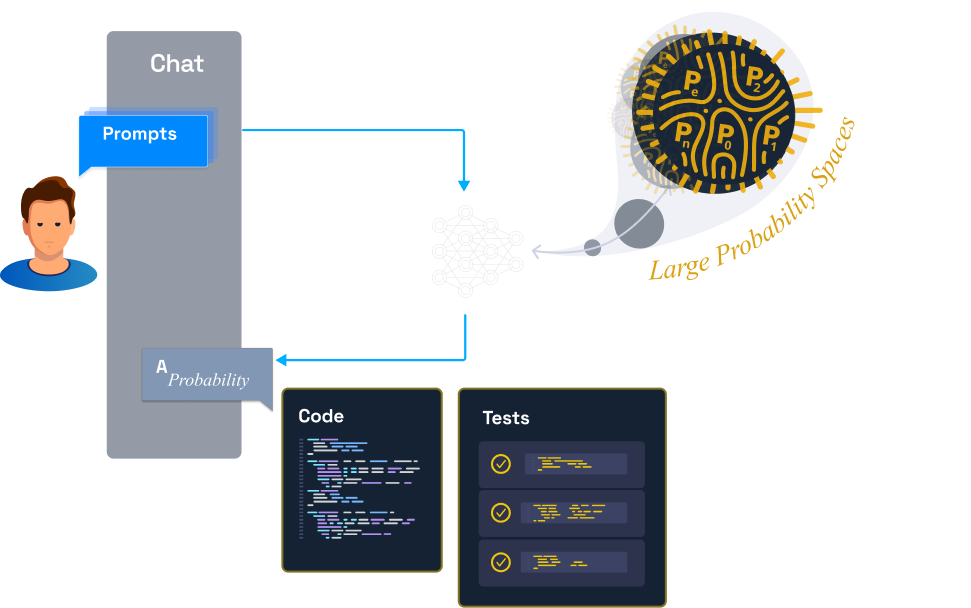
- Samples likely paths
- Edge cases are easy to miss
- Humans must manually validate behavior
LLM Agent + CodeLogician
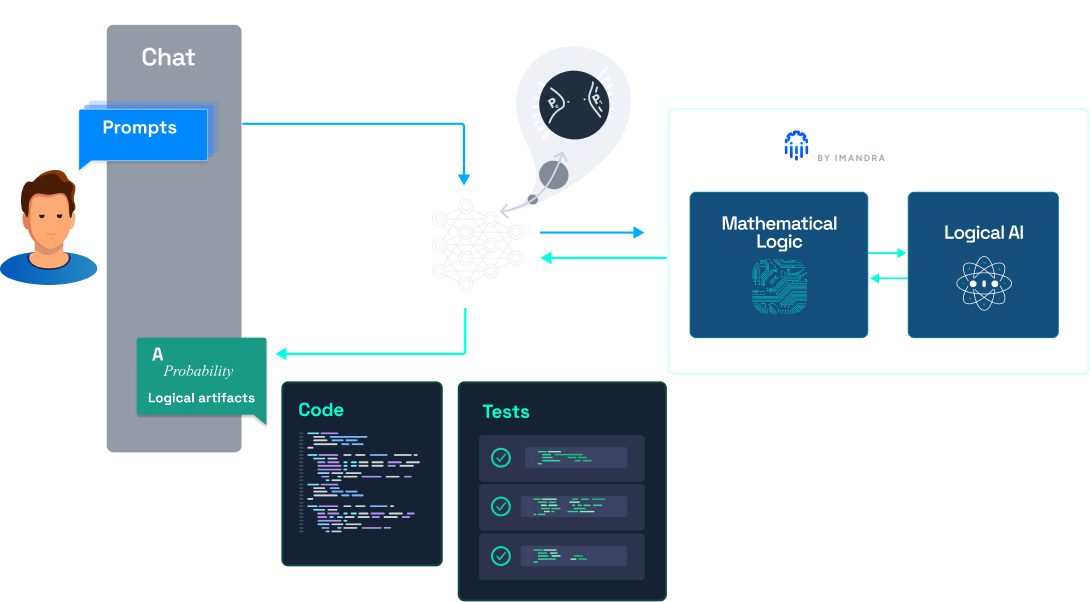
- Decision logic is formalized
- Reasoning engine explores behavior
- Artifacts expose boundaries and edge cases
CodeLogician turns AI coding from “looks right” into “behavior understood.”
Tackle Complexity with Math and Logic
CodeLogician activates when code starts encoding rules, states, or business logic — forcing the agent to translate its understanding into structured logic and using a reasoning engine to surface edge cases, decision boundaries, and invariants that LLMs alone struggle to uncover.
Not all code needs deep reasoning. But systems that encode decisions — payments, access control, workflows, distributed services — create behavioral complexity that statistical AI alone can't fully explore.
LLMs Alone Are Great For
- UI rendering and formatting
- CRUD services and wrappers
- Data transformations
- Simple scripts
CodeLogician Activates For
- State machines and workflows
- Financial and rule engines
- Access control and policy systems
- Distributed system coordination
- Complex integration logic
Read the full Tackle Complexity with Math and Logic guide here, or the Managing Complexity with Math and Logic article on Medium.
CodeLogician Performance Metrics
Comprehensive evaluation of LLM performance across multiple models and metrics
Model rankings
Benchmark data and analysis in the code-logic-bench repository.
Neurosymbolic AI for Code
CodeLogician™ is powered by ImandraX, our award-winning automated reasoning engine that combines formal verification, symbolic reasoning, and rule synthesis to provide mathematical guarantees about your code's behavior.
Real-world industrial applications in safety critical industries
ImandraX is widely used in safety-critical industries such as financial markets, robotics and autonomy, and model-based systems engineering in government and defense.
Formal verification
Mathematical verification of algorithm properties with powerful reasoning automation powered by ImandraX -- bringing formal proofs and counterexamples seamlessly into the software engineering workflow.
Region decomposition
Inspired by Cylindrical Algebraic Decomposition, this technique decomposes algorithm state-spaces into regions where system behavior is invariant, effectively computing a map of all possible system behaviors.
Seamless integration of bounded and unbounded verification
Seamlessly combine bounded model-checking and unbounded inductive proof through ImandraX. Every goal can be subjected to both bounded verification (complete for counterexamples in a precise sense) as well as unbounded verification, e.g., using Imandra's decision procedures and higher-order lifting of Boyer-Moore style automated induction.
Counter-examples
ImandraX is complete for counterexamples in a precise sense. Automatically synthesizes deep counterexamples to incorrect verification conjectures, even with recursive functions and nonlinear arithmetic, aiding discovery and eliminating time sinks from trying to prove false goals.
Imandra Discover
Discover program properties and lemmas, extract logical patterns from data (e.g., logs) and synthesize them into executable and auditable models. Identify anomalies in out-of-sample data and generate corrective actions for detected issues.
Learn more about the reasoning engine at imandrax.dev.
What developers use it for
From day-to-day code review to high-stakes system verification.
Refactor safely
Prove your refactored function is behaviorally identical to the original — or see precisely where behavior changes.
Catch bugs before production
Give CodeLogician the function and it exhaustively maps all inputs that cause unexpected outputs — before a single line ships.
Equivalence checking
Compare two implementations for semantic equivalence — useful for migrations, API versioning, and shadow deployments.
Prove invariants
Establish formal guarantees that hold across all inputs — account balances, state machine transitions, security properties.
Built for systems that can't be wrong
Payment flows
Charge logic, refunds, idempotency
Pricing logic
Discounts, tiers, edge conditions
Auth & sessions
Token expiry, permission boundaries
Matching engines
Order books, fairness, settlement
Agent plans
Agentic loop invariants, tool safety
Explore demos and examples in the repo.
Pricing
Available plans
Select a plan that scales with your automated reasoning needs, from building AI agents with reasoning skills to deploying enterprise-grade formal verification.
Imandra Universe is the ecosystem through which ImandraX, CodeLogician, and other reasoning tools are delivered.
Builder
Built for individual builders who need predictable usage.
Pro
For advanced users running heavier reasoning workloads.
Team
Collaboration and scale for teams shipping reasoning systems.
In the press and on paper
Peer-reviewed research, press coverage, and video walkthroughs of CodeLogician and the reasoning engine behind it.
Imandra Is Now Available on the Microsoft Marketplace
The Imandra Automated Reasoning Framework for Capital Markets is now available on the Microsoft Marketplace — procured, deployed, and run inside your existing Azure tenant.
BLOX Markets selects Imandra's Automated Reasoning technology to enhance Openpool Customer Onboarding and Development
BLOX Markets selects Imandra Connectivity and CodeLogician to power machine-readable connectivity, certification, and formal verification for its Openpool U.S. equities trading venue.
Scaling Logic First AI Coding to Large Projects - Part 1
Scaling logic-first AI coding to large projects with CodeLogician - Part 1.
Rigorous Edge-Case Detection for AI-Generated Code - Imandra + Gemini + Antigravity Demo
A live demo using Imandra with Gemini and Antigravity to rigorously detect edge cases in AI-generated code.
CodeLogician in the Real World: Bank Accounts & Margin Trading
Get Started with CodeLogician: Install, Configure & Use Formal Verification with Claude Code
For more research, press, and videos, see the media page.